_edited.png)
When Even the Dogs Smelled Like Oil
Updated: Oct 12

A Landscape Covered in Petroleum
Visitors to the Oil Region in the 1860s often said it was unlike any other place, not only because of what they saw but also what they smelled. Oil seeped from the ground, covered creeks and riverbanks, and mixed with mud near drilling sites. The air was full of the smell of petroleum.
Early visitors often commented on how much oil had changed the landscape.
Writers and engineers who visited during the first years of the oil boom described streams covered in oil, muddy roads soaked with petroleum, and drilling sites that left the ground stained and slippery.
Geologist John F. Carll, who studied the oil fields in the nineteenth century, described how petroleum often escaped from wells and storage barrels, spreading into nearby waterways and sometimes appearing “floating upon the surface of the streams.”² These conditions were common in the early years of drilling, when spills and waste from wells and refineries were rarely controlled.
Life in the Oil Boomtowns
The oil boom quickly turned the quiet valleys along Oil Creek into busy industrial communities. Samuel P. Bates later described the area as full of derricks, tanks, and drilling operations scattered across the countryside.³
Boomtowns sprang up quickly around the wells. Workers stayed in boarding houses and camps. Teamsters moved equipment along muddy roads between drilling sites and refineries. The smell of oil followed people everywhere, clinging to their clothes and becoming part of daily life.
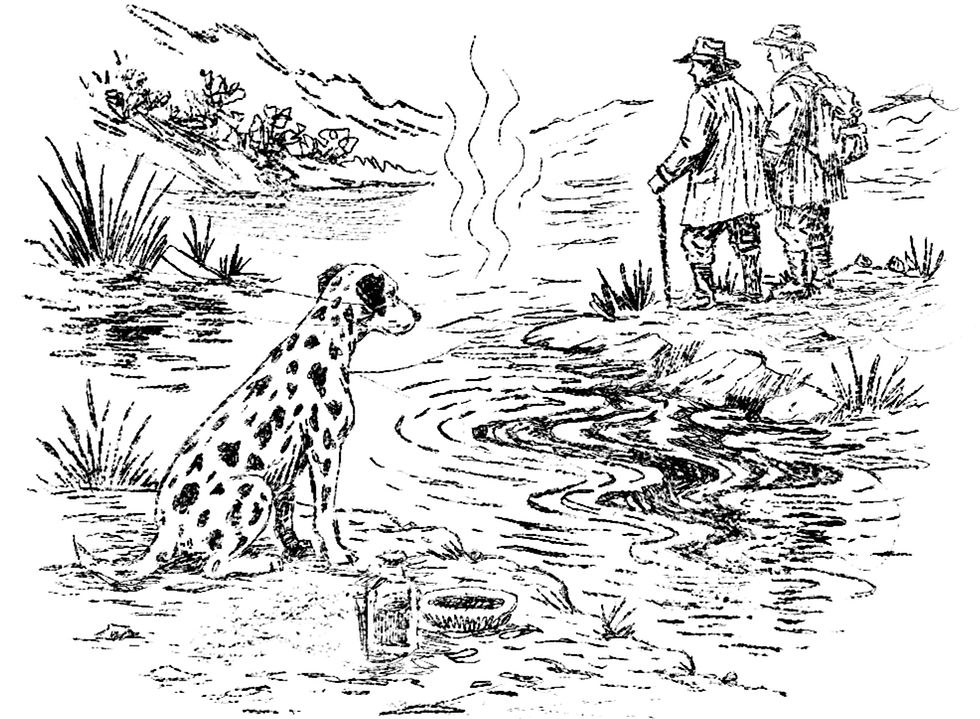
Animals were part of everyday life in these communities. Horses pulled wagons filled with supplies and barrels of oil, while dogs roamed through camps, streets, and drilling sites with the people who lived and worked there.
In these conditions, it was almost impossible to avoid getting oil on yourself. Oil collected in the mud along roads and creeks. Anyone or any animal moving through the oil fields could easily get covered in it. It stuck to boots, soaked into clothes, and stayed on the people who worked near the wells.
When Even the Dogs Smelled Like Oil
People often pointed out how much petroleum had become part of daily life in the region. Oil stained the ground, covered machinery, and filled the air with its strong smell.
People kept coming back to the same idea: oil was everywhere. It was so common that people joked that even the animals in the oil fields seemed to smell like petroleum. This saying showed just how much oil had soaked into the landscape.
While the image might sound funny today, it was based on real conditions. In the early days of the industry, oil extraction was messy and not well-controlled. Wells leaked, storage was basic, and people paid little attention to the environment.⁴
The oil boom brought wealth and new opportunities to northwestern Pennsylvania. Here, oil didn’t stay in the ground, the wells, or the barrels. It spread into the air, the water, and the lives of everyone who came for it, until even the animals seemed to carry it with them.
Today, oil is mostly hidden. It’s contained, refined, and kept out of sight. But in the 1860s, it was everywhere.
Listen to more episodes of Oil Region Tales, or visit the Venango Museum in Oil City, Pennsylvania, to explore these stories in person.
Sources
Samuel P. Bates, History of Venango County, Pennsylvania (Chicago: Warner, Beers & Co., 1880).
John F. Carll, Report of Progress in the Venango County Oil District, Pennsylvania Geological Survey (1875).
Paul H. Giddens, The Birth of the Oil Industry (New York: Macmillan, 1938).
Samuel P. Tait Jr., The Wildcatters: An Informal History of Oil-Hunting in America (Princeton: Princeton University Press, 1946).
Comments