_edited.png)
Before It Was Understood
Oil Region Tales — Episode 2
Listen to Episode 2
What was oil before it became an industry? Long before the wells, petroleum drifted across quiet water, was gathered by hand, and remained a substance people used long before they fully understood it in Pennsylvania’s Oil Region.
Listen to Episode 2 of Oil Region Tales:
A Substance Without Meaning
Long before derricks appeared over Oil Creek, and prior to the establishment of leases, pipelines, or the accumulation of fortunes, oil existed in the region. It surfaced quietly.
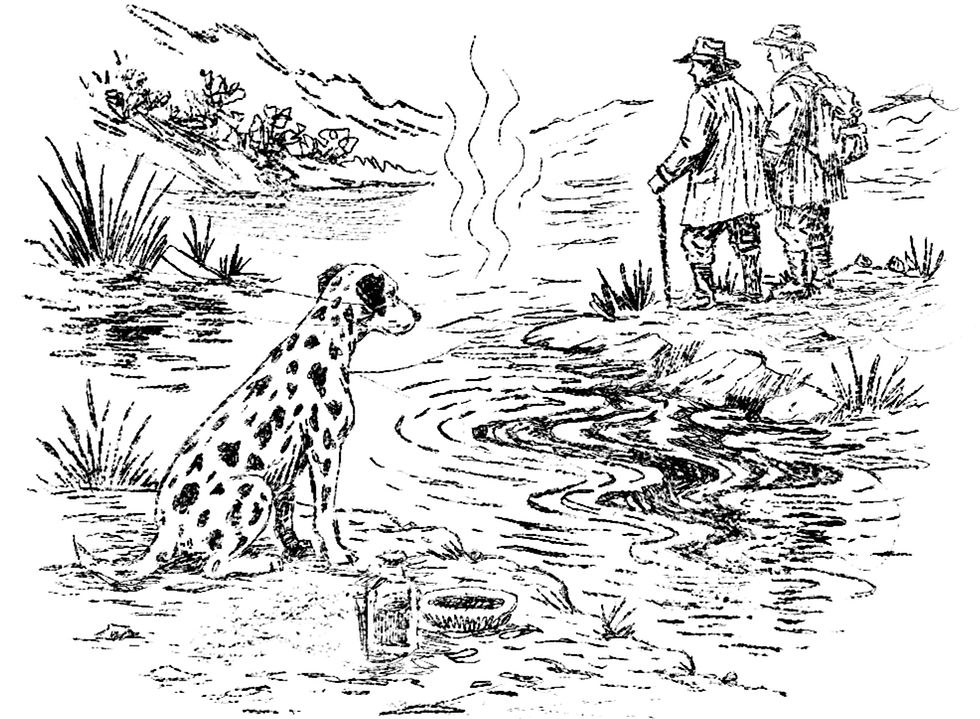
Travelers along Oil Creek and the Allegheny River initially detected oil by its distinctive odor. Subsequently, they observed a dark, oily film spreading across still water, reflecting iridescent colors and adhering to rocks and reeds. In certain locations, the oil accumulated in layers thick enough to be skimmed.
In 1819, one visitor to the region described “a spring from which issues petroleum, floating on the surface of the water "¹. Although oil was present, its properties and potential uses were not yet understood.
Known, But Not Exploited
For the Indigenous peoples of the Upper Allegheny, particularly the Seneca and other Haudenosaunee communities, oil was neither novel nor mysterious. It was regarded as an inherent aspect of the landscape, found in specific locations where it appeared to emerge naturally from the earth.
Oil was gathered from the water using feathers, cloths, or small containers. It was utilized in small quantities for practical purposes, such as topical application, transport, or distribution. Early accounts consistently note that oil was collected from the surface rather than extracted from underground sources ².
Oil was neither actively sought nor industrially exploited. It was simply recognized and utilized as needed.
From Curiosity to Commodity
However, European and American observers struggled to articulate their observations of oil.
Early nineteenth-century accounts refer to oil in uncertain terms: a “greasy substance,” a “bituminous spring,” something that floated atop the water and could be collected, though to what end was often unclear. Samuel Hildreth, writing in 1836, noted that the oil “is collected by the inhabitants and used as a remedy for various diseases "¹.
In travel narratives, oil was regarded as a curiosity, noteworthy but not yet considered significant. There was no standardized terminology or consensus regarding its purpose.
By the early nineteenth century, oil began to assume a clearer, though still limited, role.
It was sold as “rock oil” or “Seneca oil,” claimed to cure rheumatism, burns, and stomach problems. Small bottles traveled far from the Oil Region, promising a natural remedy from the earth. One widely circulated account described it as “highly esteemed as a medicine "¹.
At this stage, oil extraction and use did not constitute an industry. Rather, it represented a trade based on belief in its medicinal properties. Even during this period, oil defied straightforward explanation. Why did it appear here? Why did it burn? Why did it rise to the surface?
These questions remained unresolved. Knowledge of oil was experiential rather than scientific; it was observed, handled, and utilized, but not yet comprehensively understood ³. In all respects, oil functioned as a material lacking an established system of classification or use.
In retrospect, the most notable aspect is not merely the presence of oil, but the absence of urgency regarding its exploitation. No one rushed to control it. No one envisioned landscapes filled with derricks or streams of refined oil. Oil continued to seep as before, and individuals adapted incrementally by skimming, bottling, and using what was available.
The subsequent transformation depended on an entirely different factor. This change did not involve the discovery of a new substance. Rather, it required a new conceptualization of oil.
The oil itself remained unchanged. It consistently emerged at the surface, reflected light, and stained the water. What changed was the way people interpreted and understood oil. Once this shift in perception occurred, subsequent developments followed.
Discover more stories from the Oil Region at the Venango Museum in Oil City, Pennsylvania.
Sources
Samuel Hildreth, “Notice of Petroleum or Seneca Oil,” American Journal of Science (1836)
Paul H. Giddens, The Birth of the Oil Industry (1938)
Samuel P. Tait Jr., The Wildcatters (1946)

Comments