
While Everyone Watched the Wells
Updated: Sep 20

According to J. T. Henry’s 1873 account, Laura Drake could find sewing work. Finding time to collect it was another matter.
In his history of petroleum, Henry described the difficulties facing Laura and her husband, Edwin Drake, after they left Titusville. Financial losses and Edwin’s worsening health eventually brought the family to a borrowed cottage near Long Branch, New Jersey. Their money had run out.¹
Henry reported that sewing was available, but Laura also had children to care for and a husband who needed constant attention. Even going to collect the work meant finding time away from those responsibilities. Her earnings could not meet all the family’s needs.¹
The discovery associated with the Drake name had not secured their future. Laura’s sewing belonged to the story that continued after the well: supporting a family when money and health failed.
Her experience unfolded away from the Oil Region. Within the oil towns themselves, women’s livelihoods also appear in brief newspaper reports and advertisements.
Before the oil appeared
In Pithole, one woman’s livelihood appears in a report about her water well.
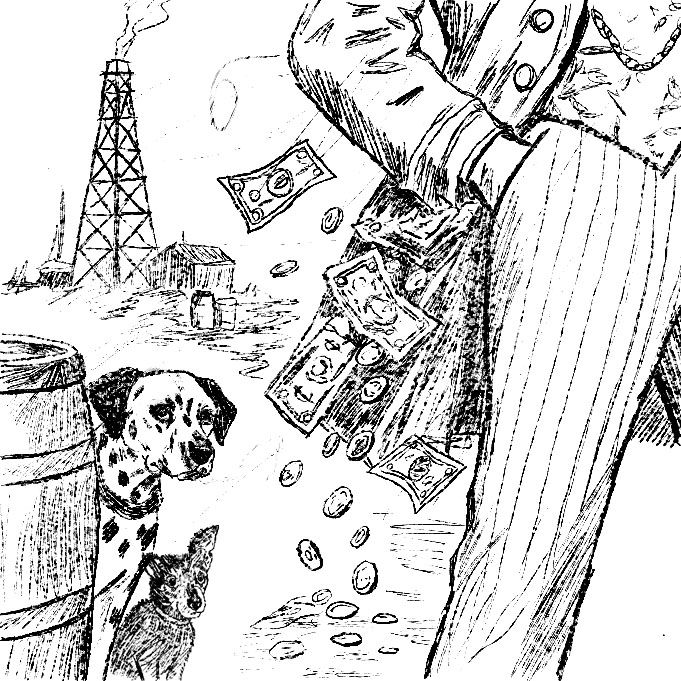
Charles C. Leonard’s 1867 History of Pithole reproduces a report from the Pithole Record dated February 5, 1866. It describes Mrs. Rickets as a widow who had “earned her living by washing.” According to the report, oil had appeared in her well, and offers for it rose from $1,000 to $2,000. It then said a prospective buyer had “secured the refusal” at $5,000 until the following morning.²
It does not establish that a sale was completed. The excitement lay in the possibility: a woman who supported herself by washing might possess a well attracting offers of thousands of dollars.
Her occupation passes in a few words. The report gives the well’s depth and its supposed rate of production, but says nothing about what she charged for washing or how much she earned. It does find room for an amused account of men competing to marry her after the oil appeared.²
That emphasis is revealing. Readers were invited to consider her possible wealth and marriage prospects. Her existing livelihood received only a passing mention.
Yet that mention matters. According to the report, Mrs. Rickets had been earning a living by washing before the offers for her well. Washing was her work, and it deserves a place in her story even without the oil.
A name in the advertisement
In 1873, an advertisement for a business bearing another woman’s name addressed potential customers in Petroleum Centre with a direct instruction: “SAVE YOUR MONEY!”
An advertisement in the October 18 issue of the Petroleum Centre Daily Record directed readers to Mrs. M. Magrane’s One Price Boot & Shoe Store, next door to Wolf’s jewelry store. It advertised a large stock and claimed prices as low as those of other sellers in
the Oil Region.³
The shop also advertised a custom department and repairs. A personal assurance accompanied the offer: “I guarantee a perfect fit in all my work.”³
Customers were being offered several reasons to visit: selection, price, work made to fit, and footwear repairs. Mrs. Magrane’s name was attached to those promises.
The advertisement does not tell us her profits or who performed each task. It does show a business presented under a woman’s name, offering merchandise and services and asking readers to become customers.
Here, a woman’s work appeared as a commercial proposition. The notice gave readers a location, described what the shop offered, and offered a reason to choose that shop. It was a practical invitation to do business.
Making a living
These accounts bring the scale of oil history down to a household, a washing job, and a shop counter.
They also record different circumstances. Laura’s sewing was part of a struggle to support her family after leaving the region. The Pithole report described Mrs. Rickets’s washing as her livelihood before her well attracted offers. Mrs. Magrane’s advertisement presented a shop competing for customers in Petroleum Centre.
These accounts reveal little about the amounts the women earned or the choices available to them. But the work itself is there: sewing for income, washing for a living, and offering goods and services for sale.
Those details change what we look for in an oil town’s history. Alongside the wells and the fortunes, people found customers, took work, and tried to cover the needs of an ordinary day.
Discover more stories from the Oil Region at the Venango Museum in Oil City, Pennsylvania.
Sources and further reading
J. T. Henry, The Early and Later History of Petroleum (Philadelphia: Jas. B. Rodgers Co., printers, 1873), pp. 326, 329–330. This is a period biographical account, not Laura Drake’s own testimony. Read the source.
Charles C. Leonard (“Crocus”), The History of Pithole (1867), pp. 27–28, reproducing the Pithole Record, February 5, 1866. Consulted in the 1945 reprint with preface and appendix by Ernest C. Miller. Read the source.
The Petroleum Centre Daily Record, October 18, 1873, image 3, fourth column, bottom: Mrs. M. Magrane’s advertisement. Read the source.


Comments